

The former Imperial Hotel (completed in 1923), designed by Frank Lloyd Wright, is known as a particularly symbolic building in the history of modern Japanese architecture. One of its distinctive design features is the use of terracotta called "Hikari-kago" (light cage) on the walls and columns.
This light cage was not merely decorative; it was designed as a device to control light and shadow, giving the architecture a unique interplay of light and shadow. However, this design did not suddenly appear at the Imperial Hotel. Tracing Wright's architectural philosophy, its origins can be traced back to the latter half of his first golden age in the 1910s.
Furthermore, tracing Wright's subsequent architectural works reveals that this concept of a light cage evolved in various forms, developing into textile blocks and then Usonian houses.
This post will examine the origins of the design of the "light cage" at the former Imperial Hotel and its subsequent development.

1 | The prototype of "Hikari-kago" - Midway Garden
The design that served as the prototype for the Imperial Hotel's "Illumination Cage" can be seen in Midway Gardens, which was completed in Chicago in 1914.
This building was originally planned as a complex of restaurants and dance halls, intended as an entertainment venue for Chicago at the time. Sadly, it has since been demolished, but it is known as an important work among Wright's decorative architecture.
Yellow bricks were used in the construction. And as an accent on the wall surface, concrete decorative panels with intricate geometric patterns were placed.
In American architecture at the time, terracotta decoration was popular, particularly in Chicago School architecture. Terracotta is an excellent material for decorative expression, but its production requires specialized factories and is therefore expensive.
In contrast, Wright focused on the plasticity of concrete as a material. Concrete can be made into any shape using formwork and can be manufactured near the site. In other words, it was a material that simultaneously possessed the efficiency of an industrial product and the freedom of sculptural expression.
This was attempted at Midway Garden
The combination of "brick wall + concrete decorative panel" is,
This later led to the "scratch brick + terracotta light cage" design of the former Imperial Hotel.
2 | The Former Imperial Hotel - A Device Called "Hikari-kago" (Light Cage)
At the former Imperial Hotel, these concrete decorations developed further, evolving into terracotta and Oya stone decorations as devices for letting light through.
The light cage is a block adorned with geometric carvings and has partial openings. It incorporates tradition within and is a device that allows light to leak through parts of the wall.
What's important here is that the lights are not merely decorative, but are using blocks as light control devices. Integrating decoration into functionality is a fundamental approach to lighting design.
The decorations are not simply pasted onto the surface of the walls. Rather, they exist as architectural devices that create light and space.
Therefore, it aimed at architectural production using mass production, which was a different philosophy from the Art Deco movement, and the theme of "integration of ornament and structure" can be considered part of that movement.
3 | The 1920s – The Birth of Textile Blocks
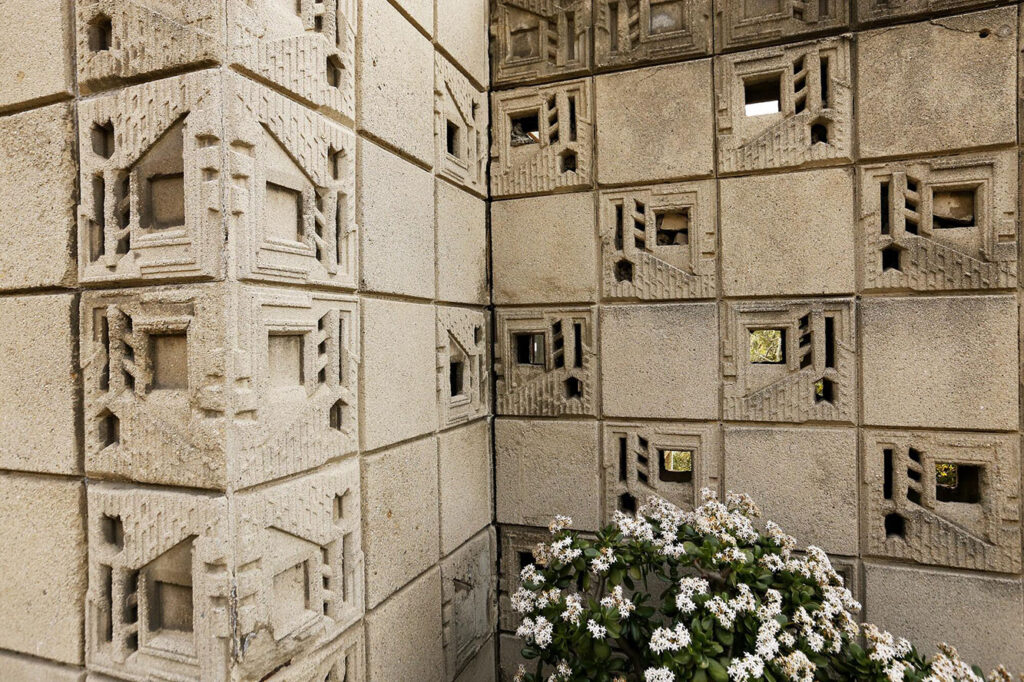
In the 1920s, Wright further developed this block concept and created the Textile Block System.
This is an architectural system used in a housing development built in Los Angeles.
Representative works include
・Millard House
・Storer House
・Freeman House
・Ennis House
These are some examples.
In this system, concrete blocks are not merely decorative, but are the very structure of the building itself.
The blocks are engraved with decorative patterns, and their repeated arrangement creates the architectural character. The blocks are connected by reinforcing bars and assembled as if weaving cloth, which is why Wright called them "textile blocks".
Here, as with the light-gathering room in the former Imperial Hotel, partially perforated blocks are used to allow natural light to enter.
In other words, the light cage of the former Imperial Hotel can be said to be located in an intermediate stage in the evolution from decorative blocks to structural blocks.

4 | An expression similar to a light cage - Richard Lloyd House
Built in 1929, the Richard Lloyd Jones House features decorative elements similar to those found in the former Imperial Hotel's skylight. Geometric concrete decorations are used on the walls of this house, emphasizing patterns of light and shadow.
During this period, Wright repeatedly studied methods of constructing architecture through the unit of blocks. In other words, designs like the light cage were not one-off designs, but rather a long-running theme in Wright's architectural philosophy.

5 | From the 1930s onward – Automatic Usonians
That is the Usonian Automatic House.
From the 1930s onward, Wright made even bolder attempts.
This is a housing system using concrete blocks, developed with the goal of creating a house that anyone can build.
Wright aimed to solve America's housing problems,
- inexpensive
- Mass production
- Self-buildable
I was envisioning a house that would meet those conditions.
In this house, the block forms are standardized, and ornamentation is almost completely eliminated. There are no intricate carvings like those found in the old Imperial Hotel's lanterns.
Furthermore, the blocks were assembled with reinforcing bars and designed to be built with simple construction methods.
Furthermore, Wright even went so far as to mix the sand from the site to create the concrete.
However, in reality, quality control of the materials proved difficult,
and the results were not always as ideal.
Nevertheless, this experiment reveals that Wright was not merely a sculptor, but an architect who considered the social production system of housing.
6 | Meaning of "Hikari-go"
When you view the Imperial Hotel's "light Cage" within the context of Wright's architectural work, its place becomes clear.
- Midway Garden → Yellow brick + decorative panels
- Imperial Hotel → Scratch tiles + decorative terracotta that manipulates light + decorated Oya stone
- Textile blocks → Integration of structure and decoration into a single material.
- Automatic Usonian → Mass-produced housing system; standardization of blocks
In other words, the light cage was an important design element in Wright's architectural philosophy, representing an evolutionary process from ornament to structure.
It was not merely beautiful decoration.
It was part of Wright's long-standing experiment in unitizing architectural components and integrating light and structure.

summary
The light kage of the former Imperial Hotel is often discussed as a unique decorative element in the history of Japanese architecture.
However, when viewed within the context of Wright's architectural work, it is not an isolated design.
It was part of a long experiment in concrete block architecture, beginning with Midway Garden in the 1910s, followed by the Textile Blocks of the 1920s, and then the Usonian Houses of the 1930s.
Throughout his life, Wright focused on architecture.
- Industrial production
- structure
- Decoration
- light
He continued to think of these as an integration.
The light cage at the old Imperial Hotel can be said to be one of the moments when that philosophy was most beautifully manifested.